C-01 Open Innovation Cybersecurity · AI · Mobility 2025 · Ministry of SMEs and Startups · Lead PM
How 9 deep tech companies got in front of the right corporate teams
The technology was validated, but nobody knew which department or which role at the large corporation they had to meet. The founders had already handed out business cards at several events, and each time it ended with “we will take a look.”
What I did- We broke down the technologies of the 9 companies element by element and first built a pre-matching plan that named the specific department at each demand-side company
- 각 사를 현장 방문해 1:1 컨설팅으로 제안 논리를 다시 썼습니다, 기술 설명이 아니라 상대 부서의 KPI 언어로
- Designed the event as an 8-min tech pitch → 90-min 1:1 networking → 30-min open consultation, so people left with a next meeting rather than a business card
Results- All 9 companies matched 1:1 with large and mid-sized enterprises
- 3 PoCs in discussion with a major telecom group, including 1 confirmed registration as a public-project partner
- One company was connected to a Middle East capital review through a securities firm's overseas advisory line
What we learned hereLarge corporations do not buy “good technology.” They buy something that will hit the responsible department’s targets for this year on its behalf. Matching does not start at the event venue; it starts with finding out the other department’s KPIs.
C-02 Growth Strategy Secondary batteries · immersion cooling · ESS 2023 · Gyeonggi Province · Lead PM
An energy company shut out of large projects for lack of references
They had the technology but no one who had “actually used it,” so they kept stalling at the threshold of large national projects. No references meant no projects, and no projects meant no references — a closed loop.
What I did- We selected 12 of 41 local companies and rewrote the selection criteria “to look at the same things the performance metrics look at”
- We brought in 4 large manufacturing and finance corporations for a 90-minute group consultation, then locked 4 weeks of individual follow-up meetings into the schedule
- Designed the collaboration as a joint project proposal rather than a technical validation
Results- Established a collaboration structure with a prototyping specialist
- Selected for a KRW 9 billion R&D project (linked to an overseas new-city project)
- 같은 프로그램에서 10개사 대상 20 matches, 투자유치 2 · 기술협업 11 · 사업협업 7
What we learned hereWhat a company with no references needs is not an introduction but a project to put its name on with you. Matching that only gets people in the room usually ends right there.
C-03 Growth Strategy Dental Medical Devices 2023 · Gyeonggi Province · Lead PM
A medical device company with a finished product but blocked on both mass-production design and sales channels
They had made it to a prototype but had no one to do the mass-production design, and cash was running down in the meantime. Even the founder had not decided whether to solve sales channels or design first.
What I did- We created a technical touchpoint with a large manufacturer that had design capability and connected them as a joint design engagement
- We built the Demo Day panel from five VC · CVC · retail practitioners so that the review itself became a sales opportunity
- Rewrote the IR materials from “technology explanation” to “post-mass-production cost and sales channels”
Results- Started joint design of an automatic impression material injector with a large manufacturer
- Demo Day 1st place
- Led afterwards to a separate open innovation program with the same corporate
What we learned hereA bottleneck in an early-stage company is usually two problems tangled together. Often just setting the order — which one to untie first — is enough for the rest to follow.
C-09 Public Advisory Startup Policy · Open Innovation Seoul Metropolitan Government · Advisor, Startup Subcommittee
제도가 된 제안, 서울형 오픈이노베이션
Until then, Seoul's startup support was largely a structure that looked only at startups. It was thorough about grants and space, but the large and mid-sized companies those startups had to meet in order to earn revenue were not part of the policy at all.
What I did- As an advisor on the Startup Subcommittee, I proposed “Seoul-style Open Innovation” as a program
- I proposed a structure that treats both the demand side and the supply side as the target, not startups alone
- The design called for pre-matching on data → PoC → follow-up, not an event-day handshake
Results- After the proposal, Seoul's open innovation programs widened in scope year after year
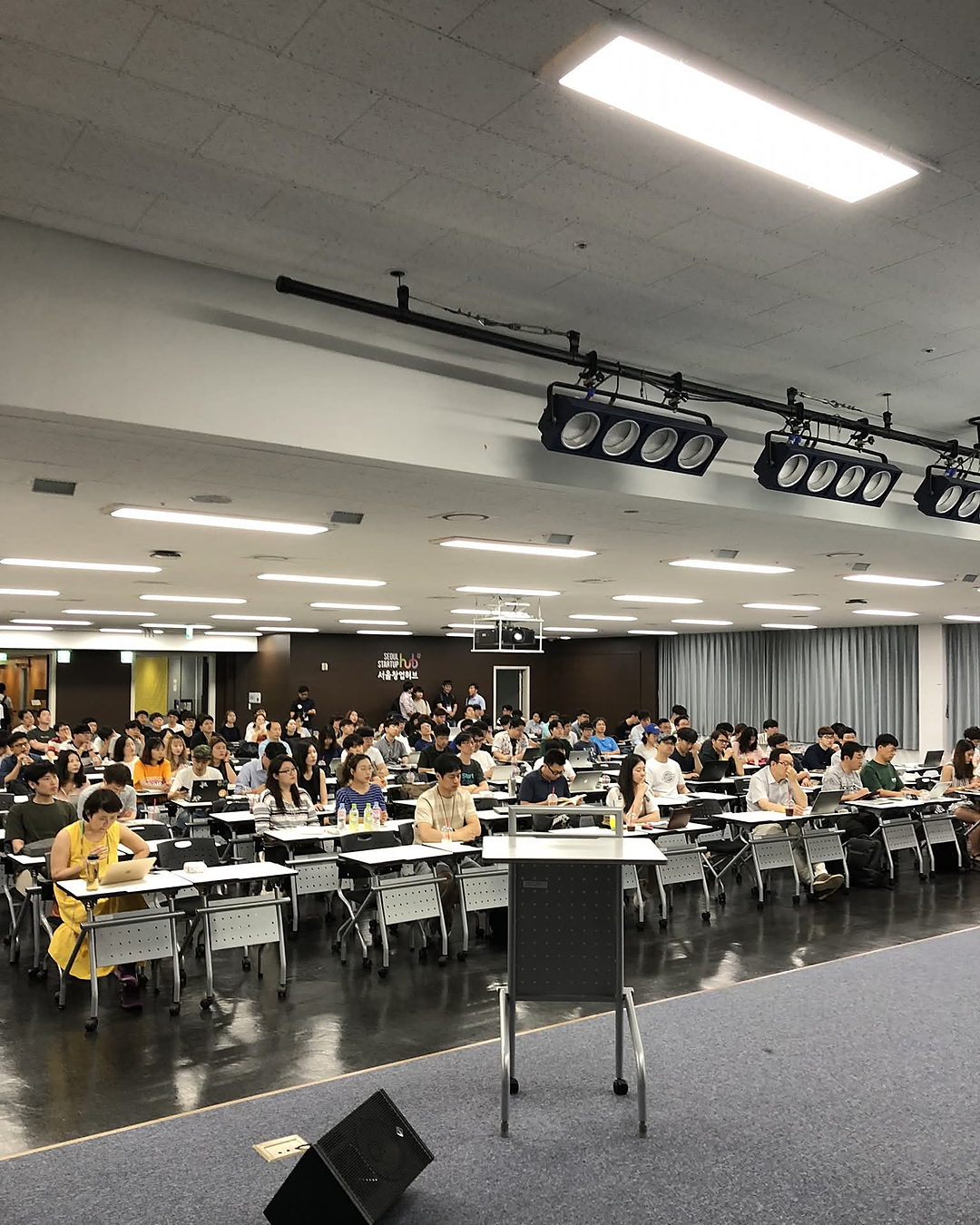
- I stayed on the ground as an operator and speaker for Seoul and district programs
- The matching structure written then became the default blueprint for closing PoCs in later MOTIE and MSS projects
What we learned herePolicy changes by redefining who it is for, not by raising the budget. Change one line — from “we support startups” to “we support the room where startups and corporates meet” — and the next year's program looks entirely different.
The expansion followed the proposal; I do not claim it as my achievement alone